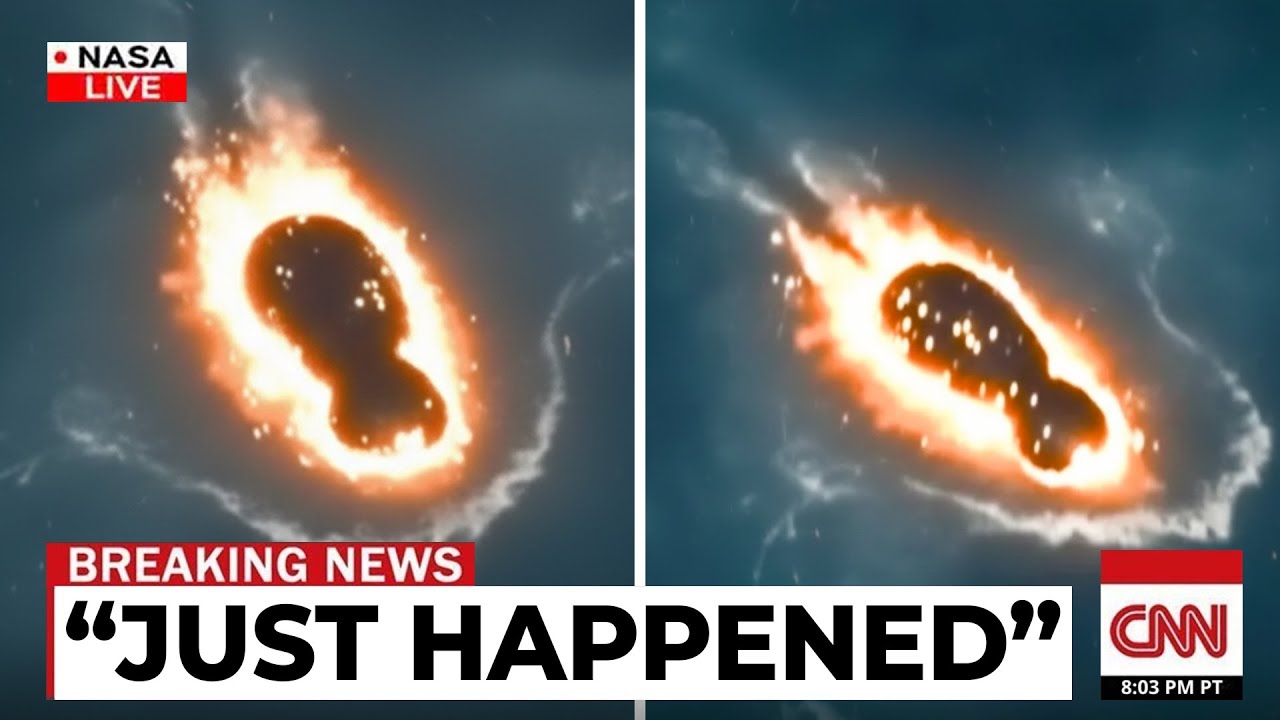
In speculative astrophysical narratives, the moment humanity first realizes it is not alone is rarely marked by calm revelation, but rather by confusion, contradiction, and the sudden collapse of trusted interpretive frameworks, and the imagery ᴀssociated with the so-called “NASA in Panic” anomaly encapsulates this precisely, depicting an elongated object entering Earth’s atmosphere surrounded by intense thermal plasma, yet conspicuously maintaining structural coherence far beyond what natural meteoroids or asteroids are capable of sustaining, a detail that immediately destabilizes conventional impact models and suggests deliberate design rather than accidental entry; according to this speculative framework, the fiery envelope surrounding the object is not evidence of destruction but of controlled interaction with atmospheric friction, potentially functioning as a thermal shield or adaptive energy-dissipation system, allowing an artificial structure concealed within a rock-like exterior to survive pᴀssage through conditions that would ordinarily result in total disintegration, a concept long theorized in science fiction as “camouflaged entry,” wherein advanced technology disguises itself as a natural body to bypᴀss early detection and defensive response.

The second and more unsettling implication arises from the object’s apparent geometry once partially revealed beneath the plasma layer, where rows of evenly spaced luminous apertures and symmetrical contours become visible, features fundamentally incompatible with random geological formation and far more consistent with engineered habitats or internal compartmentalization, leading speculative analysts to propose that the object may not be a weapon or projectile at all, but rather a mobile construct—possibly a generation ship fragment, an automated observation platform, or a dormant interstellar vessel—designed to endure long-duration travel before reactivating in proximity to a target world, and within this narrative, insтιтutional panic does not stem from imminent annihilation but from epistemological collapse, the realization that existing categories of threat, defense, and sovereignty are insufficient to describe an intelligence capable of embedding itself within what appears to be a celestial object, rendering traditional early-warning systems effectively obsolete.

Viewed through the lens of science fiction grounded in extrapolated physics, the declaration implied by the headline “It’s over for us” need not signify extinction, but rather the end of humanity’s ᴀssumption of cosmic anonymity, as the arrival—or deliberate reveal—of such an object would mean that Earth has crossed an invisible threshold, transitioning from an unremarkable biological outpost to a recognized node within a larger interstellar network, monitored, evaluated, and perhaps constrained by enтιтies whose intentions remain opaque, and in this interpretation, the true existential shock is not invasion but displacement: the sudden understanding that humanity is no longer the primary agent of narrative control over its own future, and that the universe, once perceived as silent and indifferent, may in fact be actively observing, patiently waiting for the moment when concealment is no longer necessary.
n an unprecedented astronomical event, humanity’s perception of the cosmos has been shattered following the discovery of an object that defies all known classifications of celestial bodies. Officially designated as C’s 2025R to Swan, this colossal enigma has captivated the minds of scientists, sparked a flurry of urgent speculation, and raised alarms within the global scientific community. What initially appeared to be a mere shimmer detected by spacecraft sensors has turned out to be a sophisticated and potentially monumental construct—far beyond a natural comet or asteroid.

It all began quietly, almost overlooked. On September 12, 2025, astronomers monitoring the cosmos detected an anomaly, a glitch that flickered across the sensors of the SH spacecraft. Initially dismissed as mere noise—a common occurrence in space, filled with solar flares and stray debris—beyond grasp of what was unfolding. That was until Michael Moriso, a comet expert using nothing more than a backyard telescope in Australia, captured a jaw-dropping image revealing a celestial presence unlike anything seen before. This object, with a tail stretching across the heavens five full moons wide, immediately grabbed the attention of the global astronomy community, shattering previous understandings of what such bodies could be.
Since it entered the cosmic stage, the structure of Swan has emitted beams of energy with remarkable precision, defying the characteristics of known celestial objects. The International Astronomical Union hastily ᴀssigned a name as scientists across the globe scrambled to make sense of this cosmic phenomenon. Swan R2 operates differently than anything previously charted; what others labeled as moving ice and rock has been revealed as something far more unnervingly intricate—a machine. The James Webb Space Telescope’s data revealed a metallic structure comprised of a nickel-cobalt alloy, an ultra-dense composition alien to nature as we know it. This is no mere comet; it acts with deliberate purpose, radiating energy bursts and maintaining an orbit that spans an unfathomable cycle of 22,554 years—indicating an intelligence possibly orchestrating these movements.

What has caused skepticism to ripple through the scientific community is the revelation that Swan R2 doesn’t merely traverse; it appears to possess capabilities akin to technology, with signs suggesting it holds a plasma shield capable of manipulating the solar wind. The excitement turned quickly into a tense whisper of disbelief: is it possible this object serves as something much larger at play? Observations have indicated a meticulously choreographed trajectory, aligned as it heads towards G3 Atlas, which raises palpable concerns. Something within our field of view is responding and operating, possibly orchestrated by a force much older than recognized human history.
The implications deepen with unsettling coincidences—Swan R2 is tracking an orbit that once may have brought it to Earth 22,000 years ago, around the era when ancient civilizations etched monuments that suggest an understanding of celestial cycles far beyond their time. Could it be that our myths carry echoes of these long-lost encounters, revealing a breadcrumb trail leading us back to a cosmic connection? More critically, evidence suggests that agencies like NASA are operating under a veil of secrecy as accusations arise of coordinated information blackouts following the initial release of Webb’s findings on Swan. Vital data mysteriously disappeared from public servers, resulting in an abrupt silence when key details should have spurred greater inquiry.

This has sent alarm bells ringing. An insider from the Jet Propulsion Laboratory disclosed that multiple countries are on high alert, viewing Swan R2 as potentially autonomous, with capabilities not yet understood. Even as scientists are deciphering its rhythmic communications—a series of pulses mimicking mathematical patterns within the Fibonacci sequence—the urgency within military channels has escalated into covert surveillance efforts and shifts in satellite formations.
The communications trajectory from Swan R2 isn’t merely a one-way celestial stream, but shifts that appear to elicit responses from our own technology, including an erratic directional shift from Voyager 1—an astonishing development given the probe’s advanced position in interstellar space.
In this unfolding drama, a burst of gamma rays emitted at the same time when Swan R2 skimmed the sun’s magnetic field causes researchers to ponder the true reach and consequence of an object originally perceived as a mere comet. Its path obstructed the natural order of celestial movements, hinting at a manipulation of gravitational forces. What had begun as an anomaly now appears to be an unparalleled intersection of technology and cosmos, raising the stakes in the quest for understanding our universe.

Astrophysical analyses reveal it is no deception; research teams are detecting harmonious wave signatures alluringly intertwined with Earth’s own. This synchronicity sends tremors through the scientific establishment as the world grapples with the notion that Swan R2 might be making contact—or imitating communication—deepening the mystery of our existence.
As a disconcerting picture emerges, with sightings of artificial shadows cast across other celestial bodies, the implications race forward. Whether these shadows serve to protect, explore, or manipulate regions across vast distances in space remains unclear, yet they add fuel to an already burning question: what follows next? As the scientific community buzzes with vigilant urgency, this debate reveals our ignorance: if the mysteries woven into Swan R2 are beginning to unravel, then humanity stands at a threshold between monitored existence and unfathomable discovery.

As we await the next cascade of revelations, the world hovers in restless anticipation. Will Swan R2 pᴀss quietly into the void, or does it signify a shift in the very fabric of understanding the cosmos? Numerous questions loom heavy in the air: who built Swan R2 and to what end? Have we been unwitting participants in cosmic history? One lesson looms clear; our universe might not be as empty as once thought. The possibilities now stretch as wide as the stars, saturating every thoughtful conversation on our origins and the destinies that lie ahead. As the truth of the matter weighs more heavily than ever before, the world turns its gaze skyward, awaiting answers that could reshape everything we believe. Welcome to the new frontier of cosmic discovery. The ice has been broken, a door has been cracked, and our belonging to the universe hangs in the balance. Stay attentive; this unfolding cosmic narrative continues to amplify as we speak.