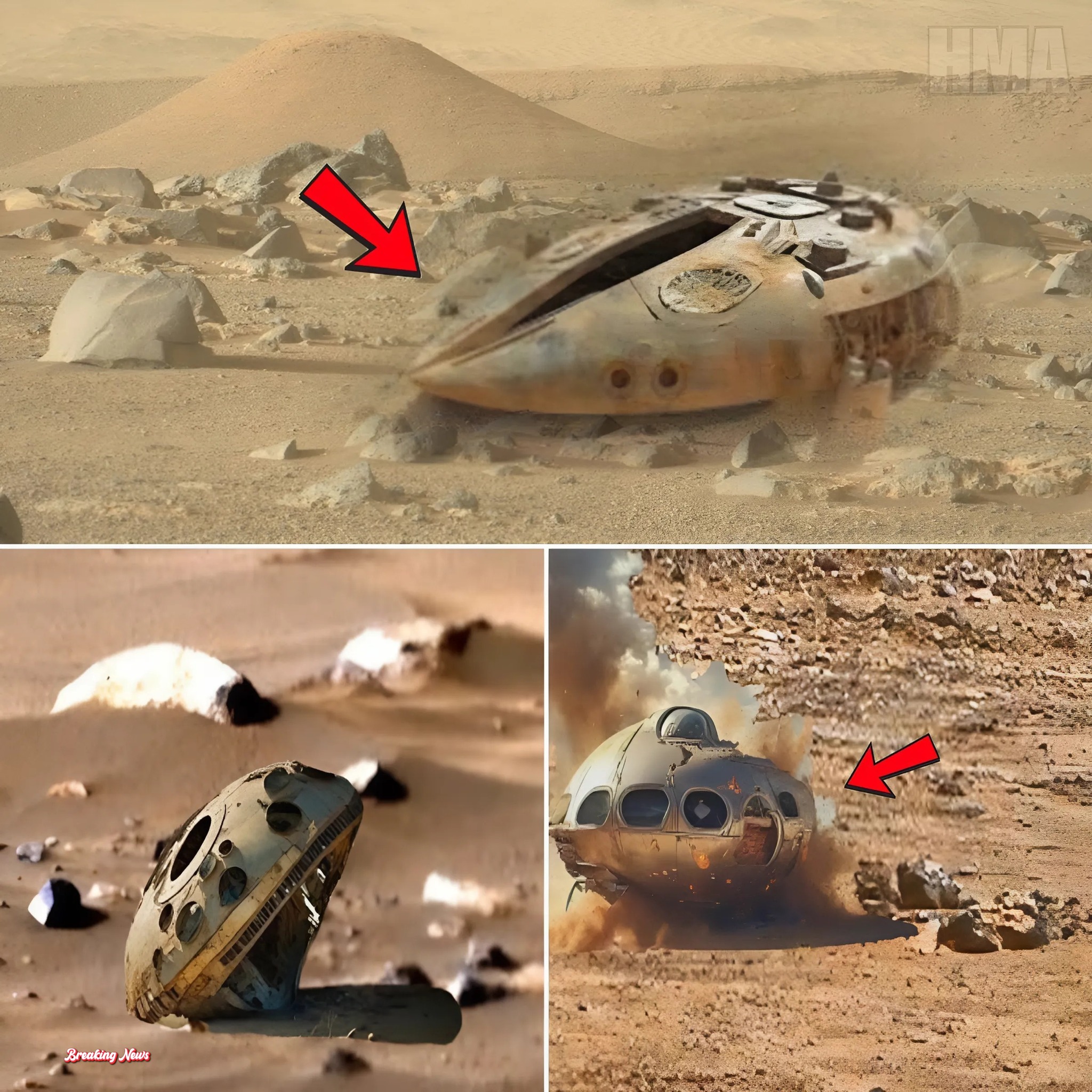
From the standpoint of conventional astrophysics, the image before us could be dismissed as an imaginative reconstruction or a cinematic artifact, yet when examined through the lens of speculative science and long-form cosmic analysis, it becomes something far more unsettling: a visual hypothesis of an ancient extraterrestrial encounter preserved in planetary memory rather than historical record, suggesting that humanity’s isolation in the universe may be an illusion maintained not by absence, but by time itself, and according to reconstructed speculative timelines, the object depicted—partially buried in a barren, Mars-like desert, its metallic hull corroded by aeons of exposure—could represent the remnants of an interstellar probe or manned craft that arrived within our solar neighborhood long before modern civilization, possibly between 120,000 BCE and 10,000 BCE, a period marked on Earth by early Homo sapiens migration and on Mars by the final stages of atmospheric collapse.

Within this framework, the craft’s disk-like geometry, reinforced seams, non-aerodynamic curvature, and modular access ports contradict every known principle of human aerospace engineering, particularly when one considers that such a structure would be catastrophically inefficient under Earth-based propulsion paradigms yet entirely plausible under hypothetical Alcubierre-inspired spacetime compression or magneto-gravitic field manipulation technologies theorized in late 21st-century physics models; the desert setting itself, eerily similar to Martian regolith compositions identified by NASA’s Curiosity and Perseverance rovers between 2012 and 2025, suggests that the craft did not crash violently but descended deliberately, settling into sediment layers that later hardened, implying a controlled landing followed by abandonment rather than destruction, and this distinction is critical, because it reframes the narrative from accidental visitation to purposeful arrival, raising the question of intent—was this vessel a scout, a research platform, or a refuge from a dying world?

This question is further complicated by the object’s apparent damage patterns, including localized breaches, oxidized surfaces, and structural asymmetry consistent with prolonged exposure to radiation storms rather than impact trauma, a detail that aligns disturbingly well with astrophysical models describing the fate of planets orbiting red dwarf stars, where intense stellar flares can strip atmospheres over geological timescales, forcing any advanced civilization to pursue interstellar migration not as conquest, but as survival; if we extend this speculative logic outward, the craft may not originate from our solar system at all, but from an exoplanet located within 40 to 60 light-years of Earth, possibly within regions now known to host Earth-like candidates such as the TRAPPIST-1 system or the former habitable zones of Kepler-186f-like bodies, worlds that could have flourished billions of years before Earth’s technological awakening and collapsed long before humanity learned to observe the stars.

Within this context, the image becomes a symbolic convergence point, where archaeology, astronomy, and speculative anthropology intersect, suggesting that what we call UFOs are not visitors from our future or present, but relics of civilizations whose timelines ran parallel to the universe yet never intersected with ours consciously, and this reinterpretation dissolves the simplistic narrative of invasion or surveillance, replacing it with a more sobering cosmic reality: that intelligence may be common, but survival rare, and that the galaxy may be littered not with empires, but with tombs; the object’s semi-buried state reinforces this interpretation, evoking parallels with terrestrial archaeological finds such as Ötzi the Iceman or Göbekli Tepe, where preservation occurs not through intention but through environmental stasis, implying that the craft—and possibly its occupants—were not retrieved, not remembered, and not recorded, because no one remained to do so, and in this sense the image does not “prove” UFOs in the simplistic tabloid sense, but proposes something far more profound: that extraterrestrial intelligence may have existed, traveled, failed, and vanished long before humanity was capable of recognition, leaving behind silent artifacts that defy classification because they were never meant to be found, and if such a scenario holds even partial truth within the vast probability space of the universe, then the real implication is not fear of contact, but humility, for it suggests that Earth may currently occupy a fleeting moment of habitability and technological ascent that countless worlds achieved and lost before us, making the question not whether UFOs are real, but whether we will one day become them—derelict evidence of ambition scattered across a future desert under an alien sky.