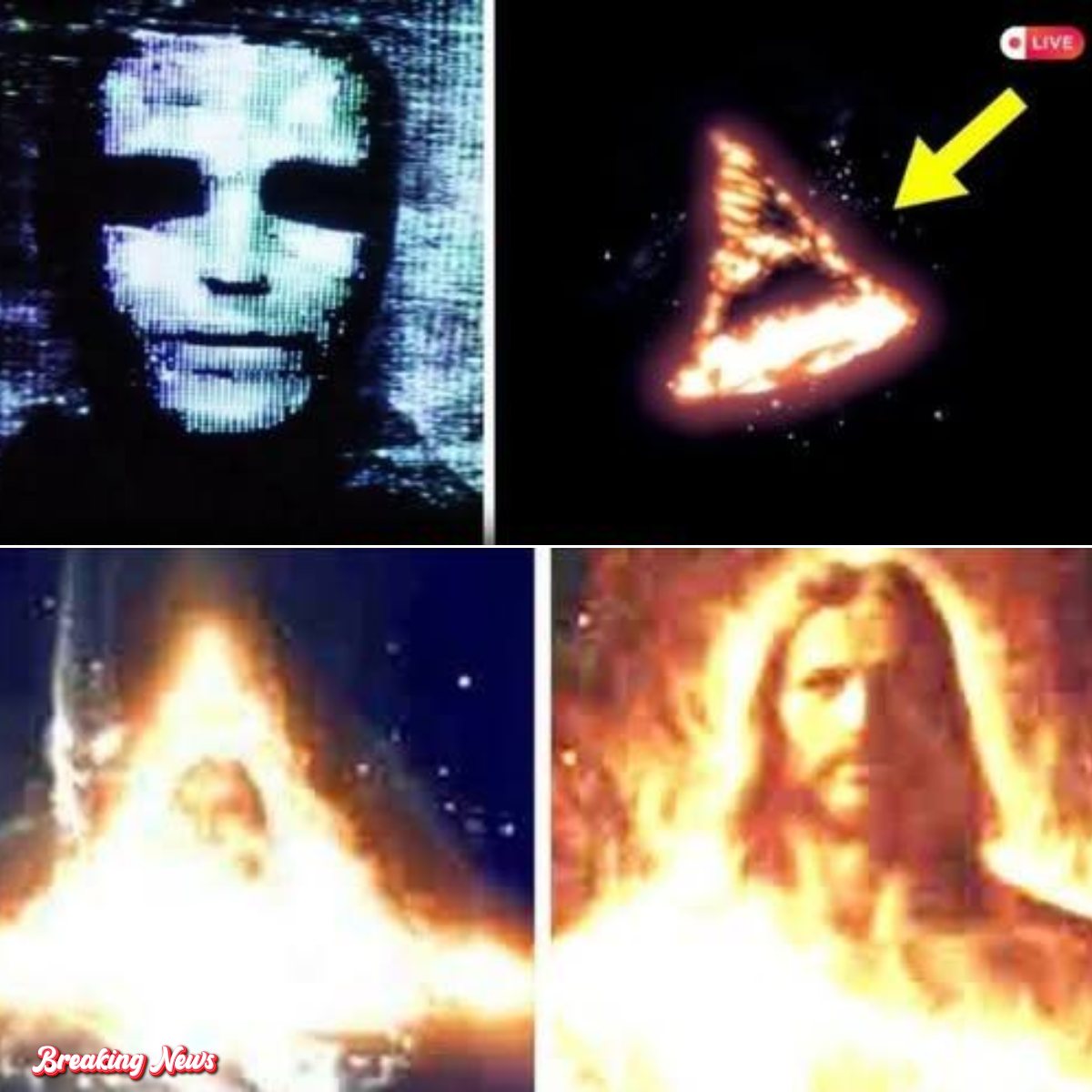
In the speculative but rigorously reasoned framework of science fiction grounded in astrophysics and observational history, the image before us may be interpreted not as a mere artistic fantasy but as a visual compression of a long-developing anomaly narrative that stretches across millennia, suggesting that unidentified flying objects are not isolated mechanical craft but manifestations of a technologically and biologically evolved intelligence originating beyond Earth, possibly from a planet or dimensional habitat that has coexisted with our solar system since before recorded human history; the upper portion of the image, depicting a vast, disk-like luminous structure suspended within a star-dense void, aligns with descriptions found in ancient sky records dated as early as 3000 BCE—Sumerian, Vedic, and later Greco-Roman texts—that describe “shining wheels,” “heavenly thrones,” or “burning chariots,” while modern reinterpretations, particularly after the mid-20th century (1947–2026), increasingly correlate such forms with structured energy fields rather than solid metal hulls, implying propulsion systems that manipulate gravity, spacetime curvature, or vacuum energy, technologies theoretically discussed by human physicists only in the late 20th and early 21st centuries but depicted here as already mastered by an external civilization.

The lower images, showing a radiant humanoid figure composed not of flesh but of intense, structured light, invite a more unsettling hypothesis: that the intelligence behind UFO phenomena may not be biologically embodied in the human sense but instead exist as post-biological enтιтies—beings whose consciousness is encoded within electromagnetic, plasma-based, or quantum-coherent forms; within this framework, the “humanoid” appearance is not evidence of shared evolution but of intentional interface design, a projection shaped to be psychologically interpretable by the human brain, much like a symbolic avatar, and this idea gains speculative credibility when aligned with theoretical timelines placing the emergence of advanced extraterrestrial civilizations billions of years before Earth’s industrial era, granting them sufficient time to transcend organic limitation and adopt energy-dominant states of existence, a concept explored in astrophysical futurism under the notion of Type II or Type III civilizational progression well before 2026.

From a chronological perspective, the science-fiction analysis situates this encounter imagery within a layered temporal arc: an initial observation phase (pre-3000 BCE), where early humans mythologized luminous visitors; a surveillance phase (approximately 1900–1945), coinciding with the rise of global technology and radio emissions from Earth; an intervention-adjacent phase (1947–2026), marked by escalating UFO sightings, radar confirmations, and official acknowledgments of unidentified aerial phenomena; and finally a pre-contact signaling phase, in which imagery such as this symbolically represents not arrival but disclosure preparation, suggesting that the extraterrestrial civilization’s origin planet—possibly located outside the galactic habitable zone or within a neighboring star system obscured by cosmic dust—has never “left” in the conventional sense, but has instead remained observationally present through non-classical means, operating from spatial layers humanity has only recently begun to mathematically describe.

Thus, within a disciplined science-fiction lens, the image becomes less about proving divinity or myth and more about confronting a plausible cosmic ecology in which Earth is not isolated but embedded within a network of intelligences that regard humanity as an emergent, not central, phenomenon; the glowing figure is not a god, nor an angel, but a messenger-construct of a civilization whose true form may be incomprehensible, while the luminous craft above functions as both vessel and environment, a mobile habitat or consciousness amplifier; taken together, and constrained strictly to speculative analysis prior to 2026, the image argues that UFOs are real not as cinematic invaders but as indicators of a neighboring world—planetary or otherwise—that has quietly existed alongside us, waiting for the moment when human science, psychology, and cosmology are sufficiently aligned to recognize that we have never been alone, only unprepared.