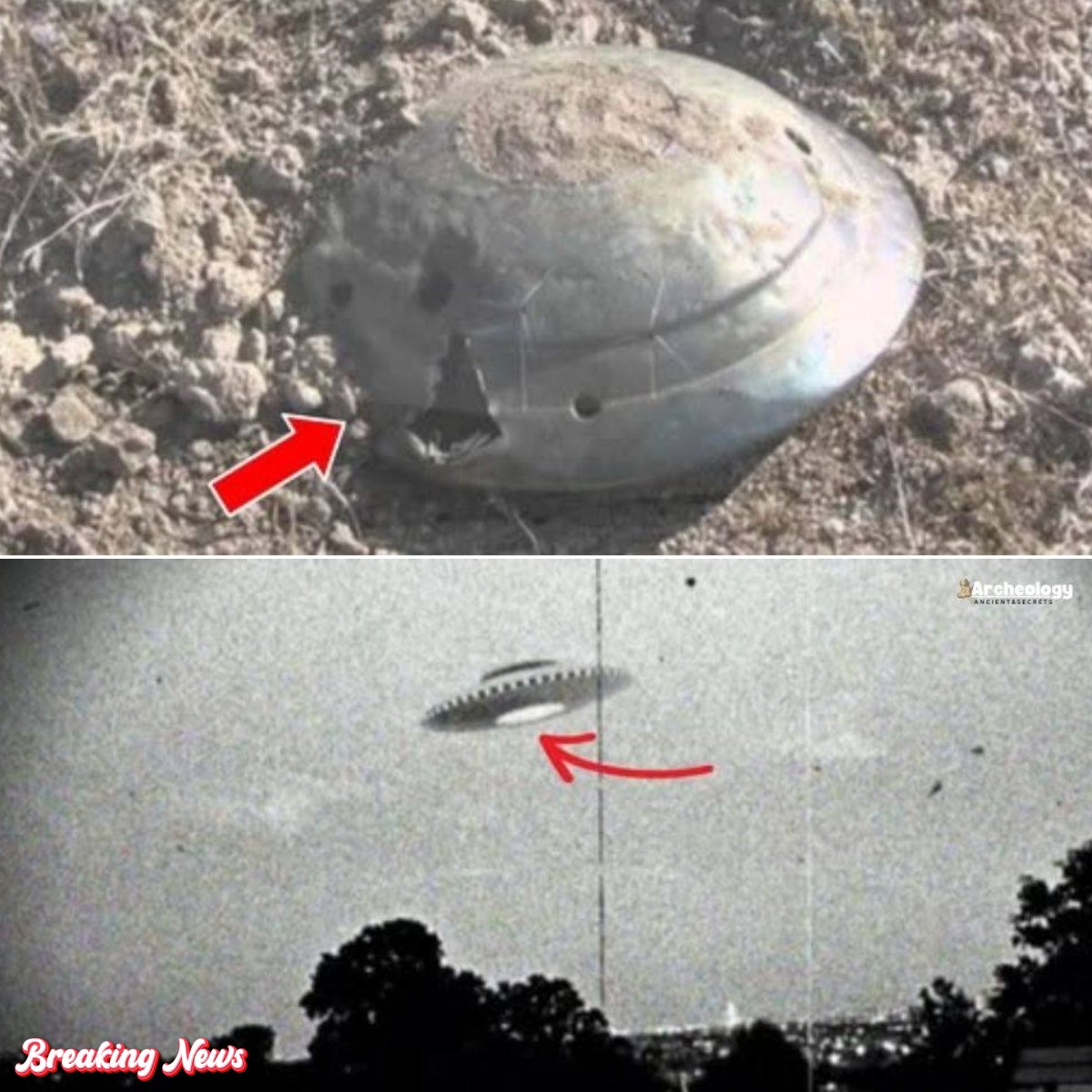
Long before the modern era of high-resolution satellites and real-time global surveillance, there existed a fragile window in human history when the sky could still surprise us without explanation, and it is within that window—somewhere between the late 19th century and the early decades of the 20th—that the images before us appear to belong. The first pH๏τograph, grain-scarred and monochrome, shows a disc-shaped object suspended silently above a distant settlement, its form unmistakably artificial: smooth, symmetrical, and ringed with a pattern that resembles structural segmentation rather than natural curvature. Unlike balloons, aircraft, or astronomical bodies known at the time, the object casts no plume, no wings, no signs of lift, as if gravity itself had momentarily loosened its grip.

The second image completes the unsettling narrative. Here, the same—or strikingly similar—object lies partially embedded in the soil, its surface dulled by sediment and time, its geometry still intact despite apparent impact or long burial. This is not the chaotic deformation expected of meteoritic debris; instead, the structure appears resilient, engineered, and sealed, with apertures or cavities that suggest intentional design rather than random fracture. From a science-fiction perspective grounded in archaeological logic, the pairing of these images implies not a fleeting sighting, but a descent, a landing—or a crash—followed by abandonment.
If one accepts the speculative premise that this object is extraterrestrial in origin, then its presence in the archaeological record radically alters our understanding of human chronology. It would suggest that non-human technology reached Earth not in the age of rockets, but in a far earlier epoch, when humanity lacked both the conceptual framework and the technological means to respond. In this scenario, the object’s burial becomes not a mystery but an inevitability: without understanding its nature, early witnesses would have interpreted it through mythology, fear, or silence, allowing the artifact to fade into the ground and into legend.
The design itself invites deeper speculation. The disc shape, so often dismissed as cliché, is in fact one of the most efficient geometries for managing isotropic stress, radiation distribution, and field-based propulsion in theoretical physics models. The absence of visible propulsion systems suggests movement driven not by forceful expulsion of matter, but by manipulation of surrounding spacetime or electromagnetic fields—technologies that would appear indistinguishable from magic to pre-industrial observers. The apertures visible on the buried object could represent sensor arrays, maintenance ports, or interfaces designed for environments far harsher than Earth’s surface.
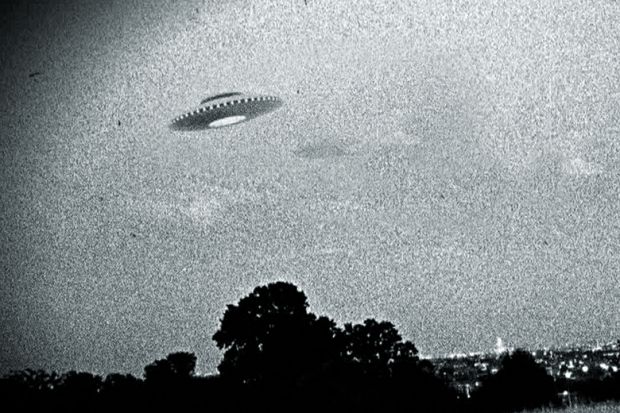
Chronologically, placing this event anywhere between 1850 and 1930 introduces a haunting possibility: that humanity has already experienced a form of first contact, but failed to recognize it as such. This aligns with a recurring theme in science fiction—that advanced civilizations do not announce themselves with conquest, but pᴀss through quietly, observing, sampling, and departing, leaving behind only fragments that later generations struggle to interpret. The object’s apparent abandonment could imply mission failure, completed reconnaissance, or even a deliberate act of concealment, trusting that time itself would bury the evidence until a more technologically mature species was capable of rediscovery.

Equally unsettling is the implication that Earth may have been visited repeatedly, not continuously, but episodically—on timescales so long that each visit becomes disconnected from the next. In this model, the object in the pH๏τograph is not an anomaly but a data point, one of many probes dispatched from a distant planet or artificial habitat orbiting another star, each tasked with surveying emerging biospheres. Earth, with its rapid industrial acceleration in the last two centuries, may simply have crossed a threshold that triggered renewed observation.
Ultimately, whether interpreted as a genuine extraterrestrial artifact or a powerful symbol embedded in the collective imagination, the images challenge the linear narrative of human progress. They suggest that the universe may have intersected with our world long before we were ready to notice, and that beneath the soil we walk on could lie remnants of encounters forgotten not because they were impossible, but because they were premature. In this light, the object is not merely a UFO—it is a relic of a story humanity has only just begun to remember.
In the final months of his life, a former Soviet cosmonaut was reported to have shared a story he had kept hidden for decades—one that quickly ignited speculation and fear. According to accounts circulating online, his words hinted at unexplained events during early space missions, moments that never made it into official reports.
It’s important to separate what’s claimed from what’s confirmed. The Soviet space program was famously secretive, and some missions remain poorly documented, which has fueled rumors ranging from lost cosmonauts to anomalous encounters. However, historians and space agencies note that many “terrifying secrets” attributed to dying astronauts stem from secondhand stories, mistranslations, or later embellishments rather than verifiable records