PASADENA, CA – A decade-old photograph from the Red Planet has returned to haunt the scientific community. An image captured by NASA’s Curiosity Rover in 2015 has suddenly gone viral across global forums, after independent analysts used modern AI-enhancement tools to reveal what many believe is a partially buried, saucer-shaped craft.
The “Anomalous Disc” of Gale Crater
The original frame, part of a routine panoramic sequence taken in the rugged terrain of Gale Crater, initially passed through NASA’s archives without much fanfare. However, the recent resurfacing of the high-resolution RAW data has sparked a firestorm of speculation.
The object in question exhibits characteristics that are strikingly non-geological:
-
Geometric Symmetry: Unlike the jagged, wind-eroded sedimentary rocks common to Mars, the object appears to have a distinct, circular rim.
-
Material Contrast: Some analysts point to a subtle metallic sheen on the exposed portion of the “disc,” which stands in stark contrast to the surrounding red oxide dust.
-
Strategic Placement: The object appears to be wedged into a ridge, leading theorists to suggest a “crash-landed” scenario from a distant epoch.
NASA’s Stance: The Power of Pareidolia
NASA officials and planetary geologists have been quick to temper the excitement. The agency maintains that the “mysterious disc” is a classic example of pareidolia—the human tendency to see familiar shapes in random patterns.
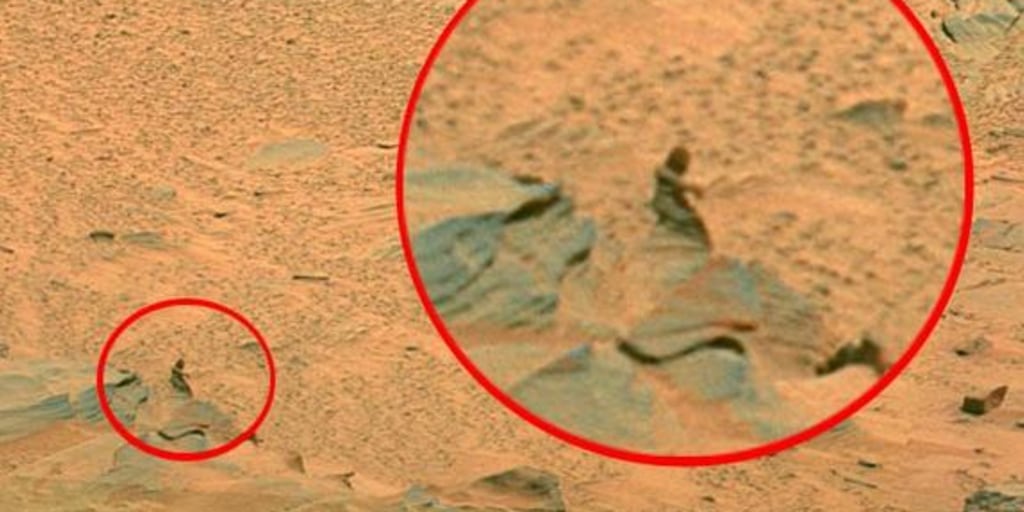
“Mars is a master of illusion,” says Dr. Elena Rossi, a planetary geologist. “Between the shifting shadows and the unique way Martian rocks weather over millions of years, it is incredibly common to find shapes that look like faces, spoons, or, in this case, saucers. What we are likely looking at is a fractured caprock, smoothed by ancient water or wind erosion.”
The Skeptic vs. The Believer
Despite the official explanation, the online community remains divided. Digital archeologists argue that the symmetry of the object is too perfect to be a product of random erosion.
“We have looked at thousands of images of Martian rocks,” says one independent researcher. “Geology has its rules. This object breaks them. The curve of the rim and the consistent thickness of the ‘hull’ don’t align with the surrounding strata.”
A Growing List of Martian Mysteries
The “2015 Saucer” joins a growing list of controversial Martian finds, including the “Doorway” caught by the Curiosity rover in 2022 and the infamous “Face on Mars” from the 1970s. While most have been debunked as shadows and perspective tricks, the sheer volume of anomalies continues to fuel the push for more aggressive exploration.
As humanity prepares for the first crewed missions to Mars in the coming decade, these images serve as a haunting reminder: we are going to a world that remains largely a mystery.